Sunday, February 15, 2015

Jezreel III

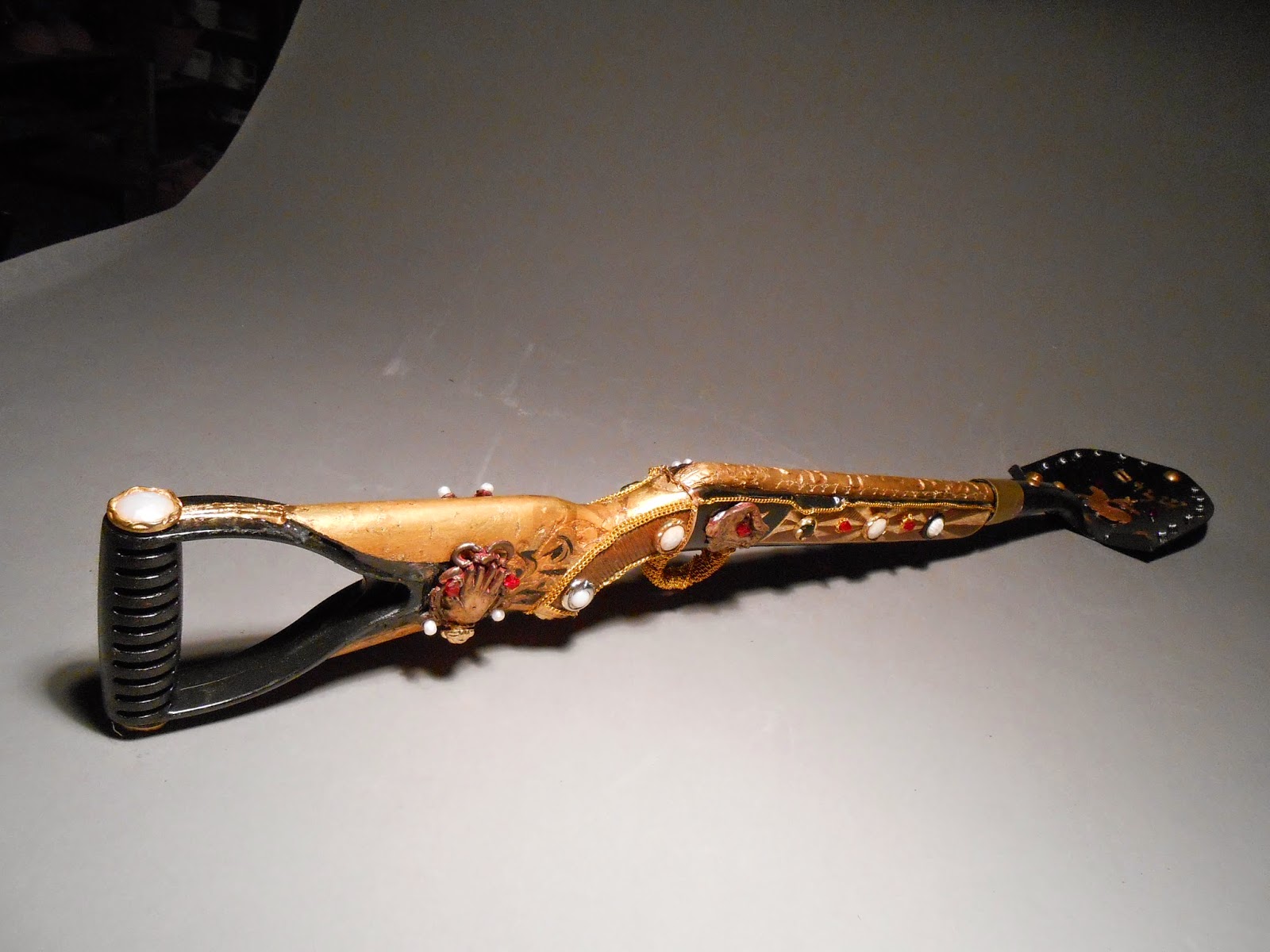
Dad gave me a broken scope from a .22 so I, per usual, made it into a sculpture. I was primarily looking at finger bone relics from the middle ages because of the cylindrical design. 


 However, I didn't know how to turn it back into a tool. Initially, I thought of filling the lens caps full of small seed so it would be a canister/nozzle apparatus thing. Then the idea hit to make it a part of a water hose. After pressure fitting and gluing, the implements were in place.
Then a coat of paint for the base (which was also derived from the finger reliquaries)...


Wednesday, February 11, 2015

Display and Surrender


I like to think about doing art as a sacrificial act. Mark 14 describes a scandalous moment between Jesus and a local prostitute (also Matt. 27 and Luke 7). She enters where Jesus and the disciples are breaking bread only to break an alabaster jar and start rubbing the perfume inside onto Jesus’ feet with her hair. Clearly this clingy woman of the night has no boundaries or even common sense. People there recoil at the amount of money it could have been sold for to give to the poor. It seems senseless.

However the vase wasn't just expensive; it represented the woman’s entire life and livelihood. Families kept vases like these almost as a status symbol, costing an upward of a years wages. This jar was an heirloom of sorts. This one she had turned into the toolbox of her trade. So after reading this scene we see that she wasn't wasting, but rather symbolically laying out her life onto Jesus’ feet. It had no practical purpose. No money was gained, no sustenance had, but the woman was now liberated and Christ was now exalted. She not only had shown a physical symbolic representation of an inward spiritual reality (like Baptism for example), but her symbolic sacrifice was also material sacrifice. It crossed over into real cost. In the end Jesus rebuked the party's rebuke, saying, “Leave her alone... Why are you bothering her? She has done a beautiful thing to me...” When appropriate, a simple display of beauty can bring much glory to God. This display was destroying an idol.

Worship in music does this. When I worship corporately, I am not the first one to physically show how I feel. I want to dance or sing super loudly, but because of my idolatry of other people's opinions, I refrain. In that situation if I danced and sang and clapped where other people weren't, I would not only be showing a physical manifestation of an inward joy, but I would also be letting go of an idol and grabbing hold of my dignity found in the Lord.

How would we do this in visual art? Initially, it's easy to see how we could use a manipulated object to point to an inward (or outward) reality. This is what art has done for ages. What does art do but point to itself or something elsewhere? However I can craft the most visually enrapturing, Gospel centered, audience loving sculpture, but if it only stays in a gallery, or further, only in my studio, then there is no Gospel in that work. The idol of self-preservation and pride is still there, Look at my thoughtfulness and skill. I would just be using the Gospel story in my work as bait to do that. I would be singing, but not worshiping. 

A crossover, mentioned before, has to happen where symbol of a reality again becomes reality. Humble Beast records creates Jesus exalting music. However, they give all of their music away for free under the moniker "Freely Given", devoted to radical generosity. The Gospel didn't stop at the end of a song; it continued in their entire business model. They are taking on the burden of finding funds elsewhere to be able to give us all their (amazing) albums. 

"Visual artists giving their work away for free? Hilarious." Maybe so, but the mindset is still correct. What about Jesus raising you from the depths of your sin makes you want to change how you work? It could be  an actual donation-type sacrifice like offering a percentage to Compassion International or International Justice Mission. Like with Humble Beast, the sacrifice relinquishes the idol of wealth while still imitating Christ's ultimate generosity. Another way is intentionally working within, say, the gallery scene with an explicit Christian message to redeem that part of culture. The idol dropped would be potentially fame or favoritism. You certainly wouldn't be picked for certain shows, but if the work is of quality, people can't ignore it or your witness. 

Somehow visual art  needs to transcend the artist and his or her own thoughts and skills. By loving the Lord, art is the medium for which not only His story is told, but also how it is displayed. Like the woman with the alabaster jar, the expression is just as important as the symbol. Surrendering idols make work all the more beautiful.

Friday, February 6, 2015

The Libyan

For our first Wood, Stone, and Steel project we had to find a master artist reference to base our work off of. The idea was to take the composition and distill it down to it's simplest forms. Created the same atmosphere without recreating the work itself.
I went Renaissance and picked The Libyan from the Sistine Chapel. The angles of the arms and legs next to the flowing mid-torso cloak offered a lot of opportunities to play.
I wanted to add two different aesthetics to it however, gothic and futurist. Gothic because I love the forms and futurist because it accents movement. It was going to be a freestanding version of what I did in high school but in an already established composition. I elongated the figure for further abstraction.
 
We made little maquettes. Or trophies, I call them. The reward of planning.


Various stages of assembly. If it isn't known already I was heavily influenced by the work of Louise Nevelson. All the wood was either pressure fit via dowels or adhered with wood glue.
                 

Threw on a coat of paint.


Sanded the edges and shot some photos!


Monday, January 26, 2015

Modern Spolia :Why Constantine and Theodoric Would Have Loved Thrift Stores


Yet another modern growing trend is the new found desire for the reclaimed. Folk music, barrel tables, Edison lamps, pipes, etc. are hardly things of this century, yet this image has become synonymous with the modern millennial. And not a collection of high-dollar, Antiques Road Show items. No, instead it is the used and battered utilitarian drum of a mining cart that’s in the corner of a New York loft. I fabricate the “worn” look on work all the time as an artist/money-maker. Thrift stores and second-hand merchants are prime targets. Cheap and sachet, even used clothing is exciting. Out with the new, in with the old.
However we are hardly the first society to ask our grandparents for their old junk. A notable proponent of this kind of old-is-the-new-black craze is none other than Roman Emperor Constantine I. It can be seen through visual evidence that he put forth a massive building initiative in the fourth century, not to create a new twist on classical style as every other ruler before him, but instead he used all of their styles, mixed them all together and called it his. This kind of reuse of older building materials is to spoliate, not unlike taking spoils of war, or leftovers. Constantine used spolia rampantly in the Latern Basilica and his famous Arch. The spolia had several uses, as written on by Beat Brenk, including legitimizing his rule, showing off power, and conservation, but an especially notable feature is that it just looked cool.
“[Spolia] are to be considered seriously as a new artistic medium which by the character of tradition and time-honored norms could be transmitted to a building: a new aesthetics, operating not with the concept of the brand-new but rather with the concept of the reuse.”
There is a look that comes along with something you didn't necessarily grow up with. A kind of mysterious life that the object brings to the current age. What has this thing seen? Were people as fond of it then as I am now? What does this being in my living room say about me to my friends?
I would say having the 1920's door as a headboard does the exact same things a remounted relief carving does. One, it relates you to a time when things weren't as complex and planned obsolescence was unthinkable. In Roman times, the Empire had been split in two, led by multiple rulers, and infiltrated with all kinds of new people and thoughts from their colonialism that the only remnant of “Good Old Rome” was in the centuries old monuments. In the same way, I may think it’s scary that everything I touch was made in a factory and that my obsidian black rectangle knows my name, so making a table from a broken wheelbarrow brings me to the here and now in a way the other things couldn't. Stability and simplicity are found under years of dust. Also, used things silently put forth that your ideas, feelings, and beliefs about how the world works are more in line with folks from way before your time than they are with now, and thus the way you think now is backed up with history. Constantine and, later on, Theodoric, found that aligning themselves with familiar imagery made the emperors (and their beliefs) more acceptable. Constantine built entire churches from former recognizable materials. This made attendees feel at least vaguely at home in this new radical religion and, I presume, it also implied that every ruler and era prior that point in time had been pointing to this idea, this belief, this building. As millennials, every old thing we have is proof that we are from a lineage of other humans before us. We can testify with these objects that the end of our lives doesn’t mean the end of our affecting someone else’s life. We aren’t as fleeting as our times.

Minia(na)ture Sculpture


There seems to be a fad among contemporary sculptors to use forced perspective to make notably unprofound objects seem grandiose because of the miniature worlds placed upon them. Looking through various posts, articles, and even at my peers’ work, there seems to be a lean toward creating small clusters of activity for the viewer to peek into and happen upon a tiny, precious civilization or biome.
SEKAI by Maico Akiba
Maico Akiba in his “SEKAI” (“world”) series, fashions pre-made animal action figures into bearers of society with the use of the green fluff found in model sets. Visually there is an obvious whole object, in this case, the triceratops. Though not a significant thing in itself, the dinosaur seems massive, benevolent, and even graceful compared to the twig trees and minuscule homes it hoists on its back, not even noticing their presence. Contrasting with the lumbering mass that is carrying it, the village is jewel-like and visually complex.
Another artist is Kyle Kirkpatrick, who, instead of beasts, uses books. However the notion is the same. A small mass is carrying occupants that force the mass to seem enormous.
Kyle Kirkpatrick
So also Pierre Javelle and Akiko Ida, but with food…
Minimiam series

And Patrick Jacobs and Kevin LCK and Dalton Ghetti and Slinkachu and…
Why?
What makes this such a thing?
This trend has happened before in book and film. The Borrowers, Honey, I Shrunk The Kids, and Stuart Little all are about people (or mice) who are having to undergo the same level of treacheries and dangers as the rest of us.
The Borrowers (1997)
We aren't having to run from grasshoppers per se, but the conclusion is that even if you were so small no one could see you, if you could all but disappear from the hum-drum of today, you would still face the anxiety, loneliness, and peril that haunts every person. On the same note, no matter how small you would be, the difference you would make could still be enormous. Influence can still be had despite size. That is why films like these are so popular with children and why these sculptures seem so playful. Who else knows powerlessness via size and knowledge better than kids? Doll houses and G.I. Joes. These personalities are miniaturized for the perspective of being able to, vicariously, look down upon ourselves to see both how fragile we are, but also how significant. And how, in the case of the sculptures, we are both very real and very cared for.
Triceratops’ with villages on their backs are also just cool.


Sources:

Wednesday, January 21, 2015

Drawings

Can't forget the good old pen, pencil, conte, charcoal, guache, eraser, chalk, paper, finger, protractor........


Sunday, January 18, 2015

Jezreel Weapons


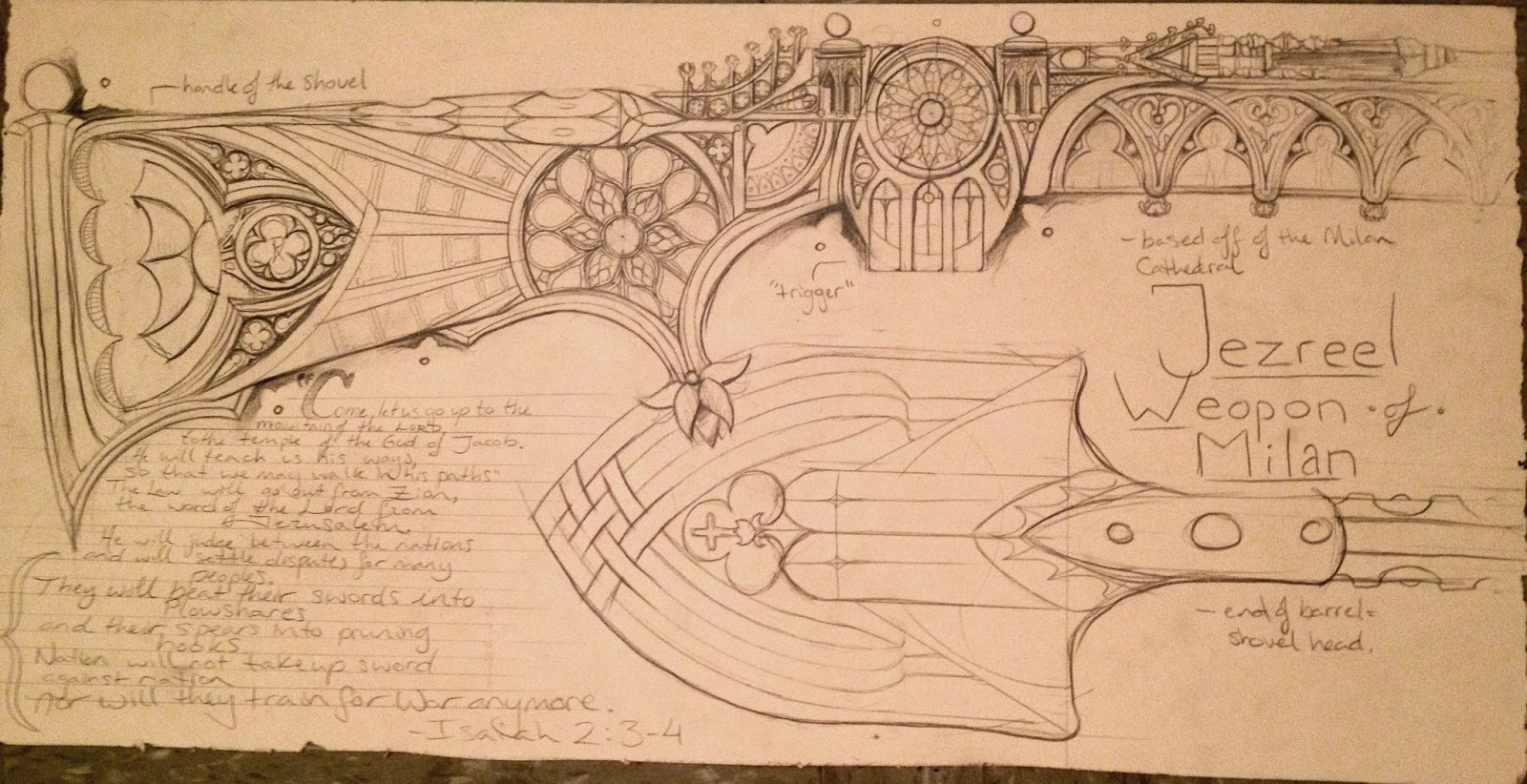
Over the summer of 2013 I had the thought of reconstructing weaponry. It was like it thwacked me over the head, I was reading through Isaiah 2:3-4 (below) about turning swords into plowshares and spears into pruning hooks. The modern equivalent to a sword is a gun. We don't use pruning hooks but we do use shovels and rakes. And the idea blossomed from there. Initially it was just a new way of reinforcing the idea of Shalom, an active, prevalent rightness with the Lord and with people as described in Genesis (Eden) and here in Isaiah.


However it became clear that this, as a body of work, wouldn't hold up for long. There were only two components, the gun and the shovel it was beaten into. Together they would merely say "make vegetables, not war" and it would go into the ocean of M-16 guitars and trumpet guns. Thus there needed to be a 3rd element.

I realized that ideologically taking a weapon used for destruction and molding it into a tool for bearing fruit is very much like what God has done to me through Jesus. I, like Paul (as we'll soon see) or any other Christian for that matter, was once against God and bent on evil. However, He chose not to destroy me but rather redeem me for His purposes. This is the gun-shovel in essence. Visually, I also discovered that covering the surface of the sculpture in ornamentation would add texture and depth (see work of Kris Kuksi). The viewer could see the initial shape, add the gun + shovel, then move in closer for a third element. So I eventually made military spolia into fruit-bearing tools with relief carvings of stories of redemption. The testimony of Paul and the story of the cracked pot that watered flowers adorn the clay pieces.


It was also around that time that the sculptures' preciousness, the fact that it is a religious thing, and "let us go up to the mountain of the Lord" sounds an awful lot like a pilgrimage brought  me to the  conclusion of making these items into relics. The texture is there in the adornment and detail, the story is there in the overall shape (the narrative relief was redundant), and it gives off the idea of sacred.


 This peace we all want cannot be reached by ourselves. Only in Christ can this be achieved. Only in Him can we bear fruit. Thus the title of these pieces collectively is "Jezreel" or "God sows".


 Many peoples will come and say,“Come, let us go up to the mountain of the Lord,
   to the temple of the God of Jacob.

He will teach us his ways,

    so that we may walk in his paths.”

The law will go out from Zion,

    the word of the Lord from Jerusalem.
4 
He will judge between the nations
    and will settle disputes for many peoples.
They will beat their swords into plowshares
    and their spears into pruning hooks.
Nation will not take up sword against nation,
    nor will they train for war anymore.


Side notes: I remember pointedly that never had I ever more wanted shalom and the Kingdom to come than after the gun violence of Sandy Hook. 

I own three guns. I am not against owning them per se. A part of living in this world of sin and death is having to kill animals to eat them and having to protect your family from harm. I pray for the day when any offensive weapon will no longer be necessary.